
Kemp LoadMaster
Knocknoc integrates with the Kemp LoadMaster to dynamically control network access. Knocknoc dynamically manages the LoadMaster's global allowlist. As users authenticate and grants expire, Knocknoc adds and removes entries in the allowlist, so access is granted in seconds.
This is an active integration: Knocknoc pushes changes to the LoadMaster directly. If you would prefer a poll-based setup where a device fetches a Knocknoc-hosted feed on its own schedule, use the EDL (Passive) Knoc type instead.
Requirements
- A LoadMaster running firmware with the RESTful API (LMOS 7.x or newer).
- The API Interface enabled so Knocknoc can reach the LoadMaster API.
- A LoadMaster user account (username and password) with permission to manage the global ACL.
- Network reachability from the host running Knocknoc to the LoadMaster management address.
Step 1: Enable the API Interface
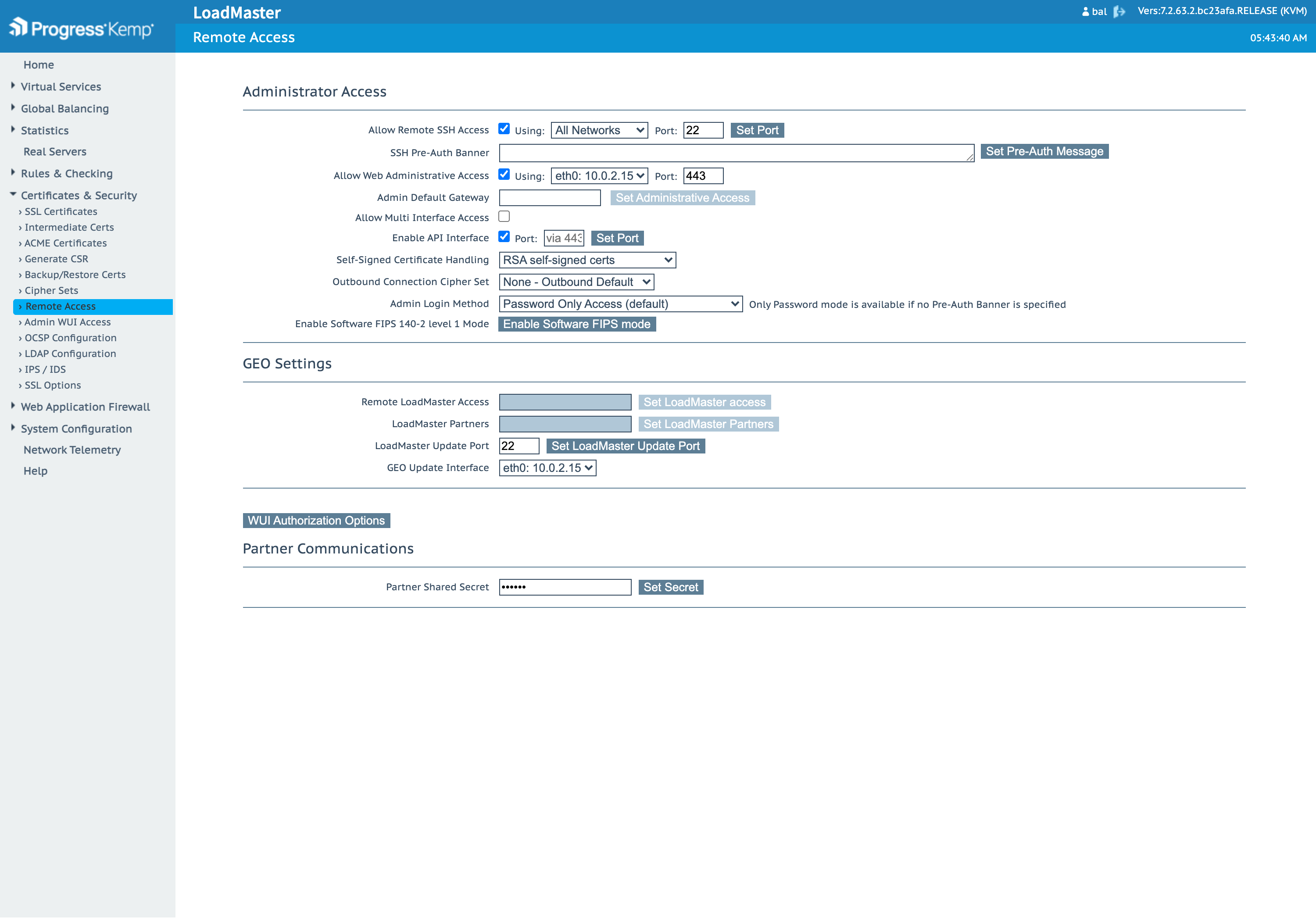
- In the WUI, go to Certificates & Security > Remote Access.
- Enable the API Interface.
- If you restrict management access by source address, allow the IP that Knocknoc connects from.
Step 2: Enable the Packet Routing Filter
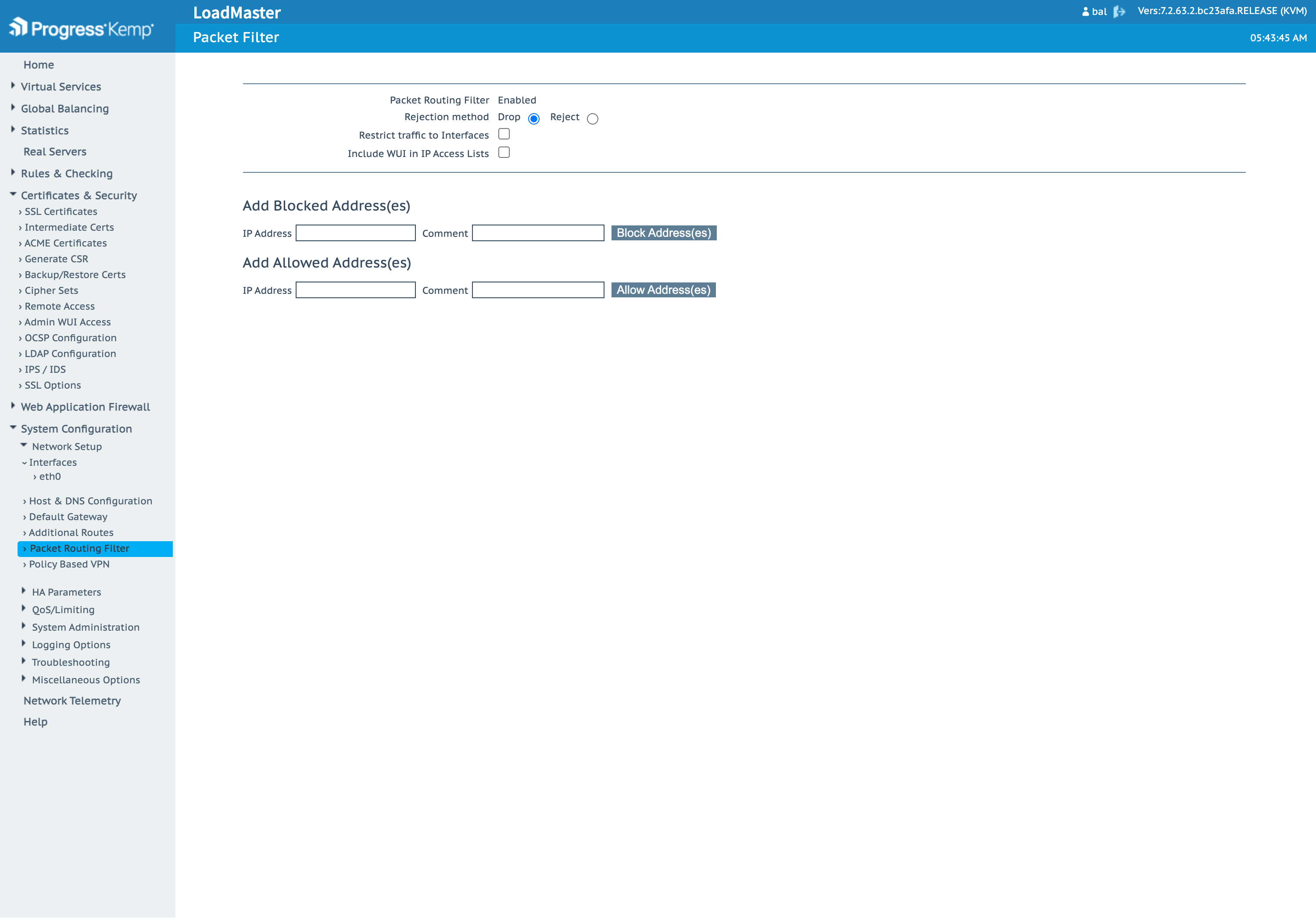
The global allowlist lives under the Packet Routing Filter. Go to System Configuration > Network Setup > Packet Routing Filter and confirm it is enabled.
Step 3: Create a user
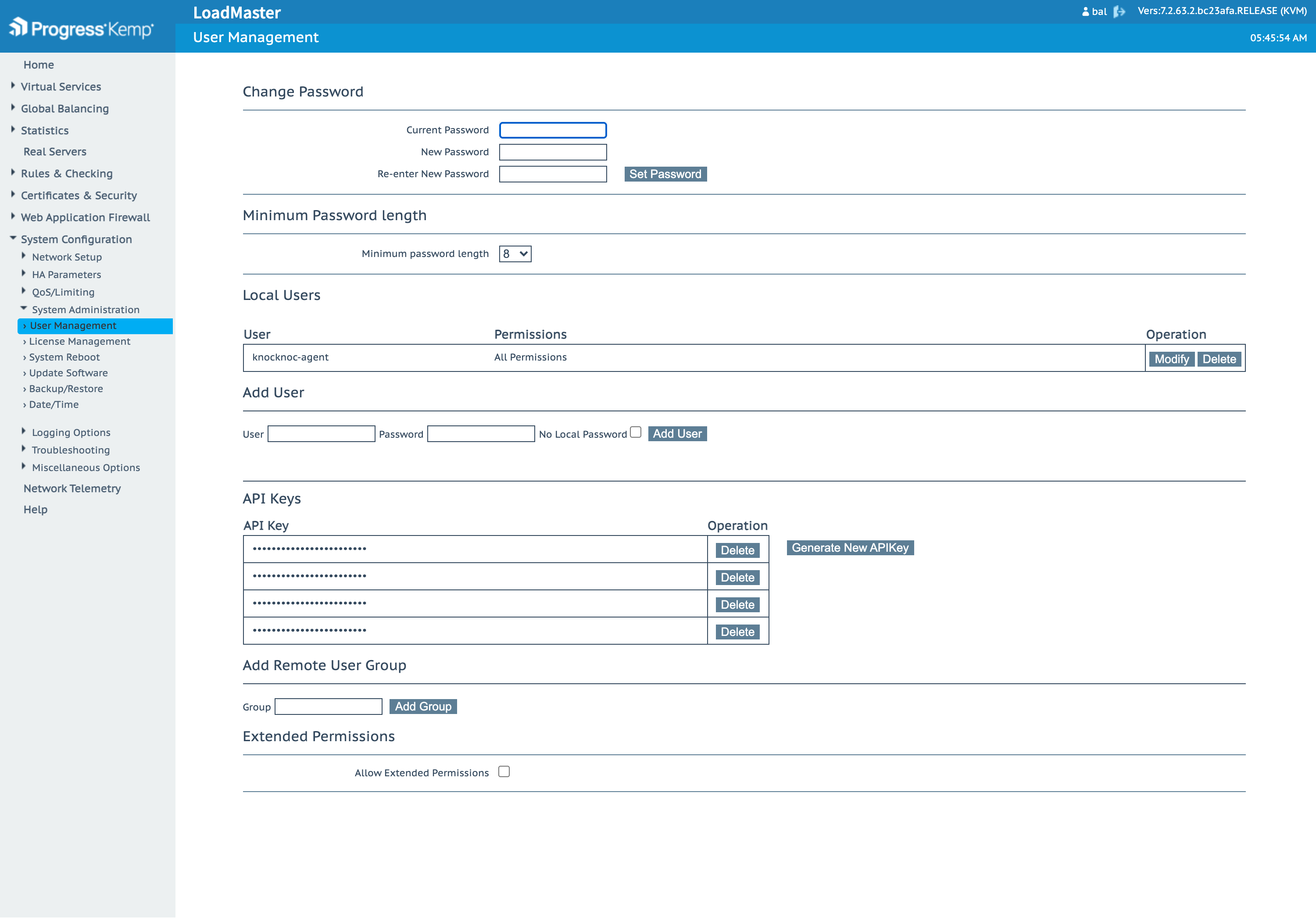
- Go to System Configuration > System Administration > User Management.
- Add a new user (for example
knocknoc-agent) with a strong password, and grant it All Permissions.
Step 4: Configure the Knocknoc Backend
In the Knocknoc admin wizard, create a Knoc and choose the Application type, Active mode, Kemp LoadMaster vendor. Fill in:
| Field | Value |
|---|---|
| Kemp LoadMaster URL | https://<loadmaster-host> (include the port if non-default) |
| Insecure | Tick only if the LoadMaster uses a self-signed certificate |
| Username | The LoadMaster user from Step 3. |
| Password | That user's password. |
Click Validate connection to confirm Knocknoc can reach the LoadMaster and read the allowlist, then save.
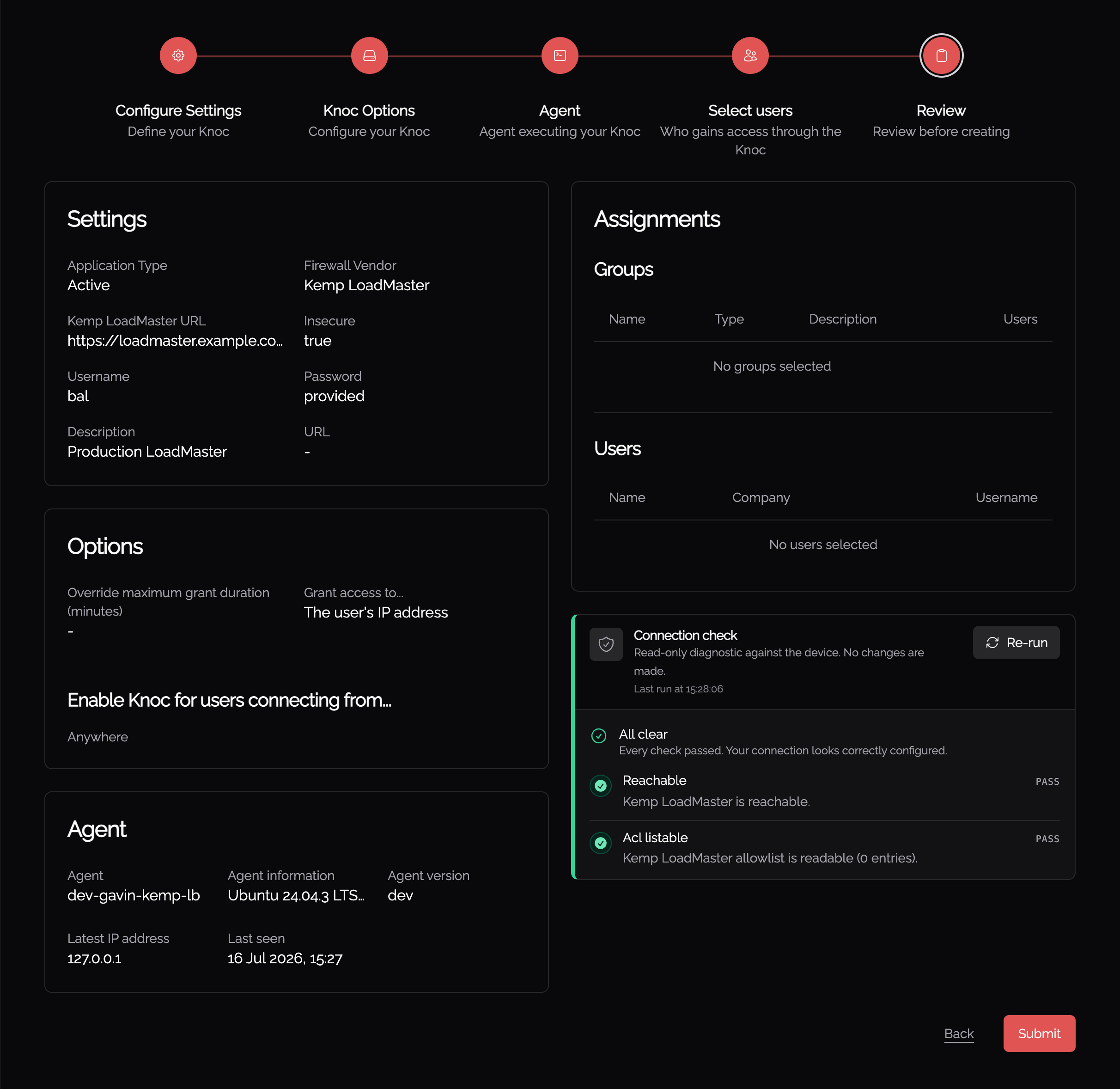
The create-knoc wizard walks through the following steps.
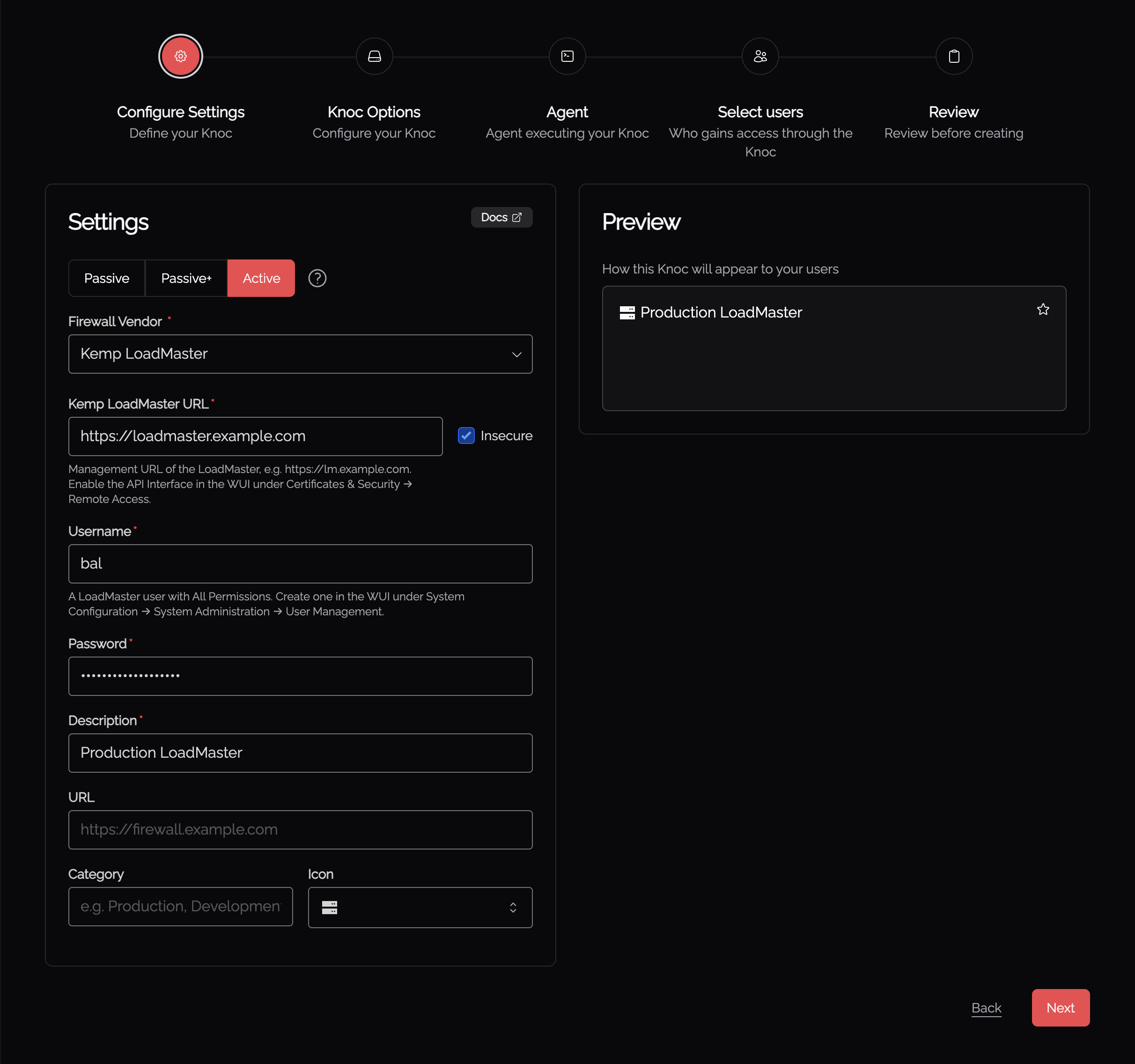
Configure Settings - choose the Active mode.
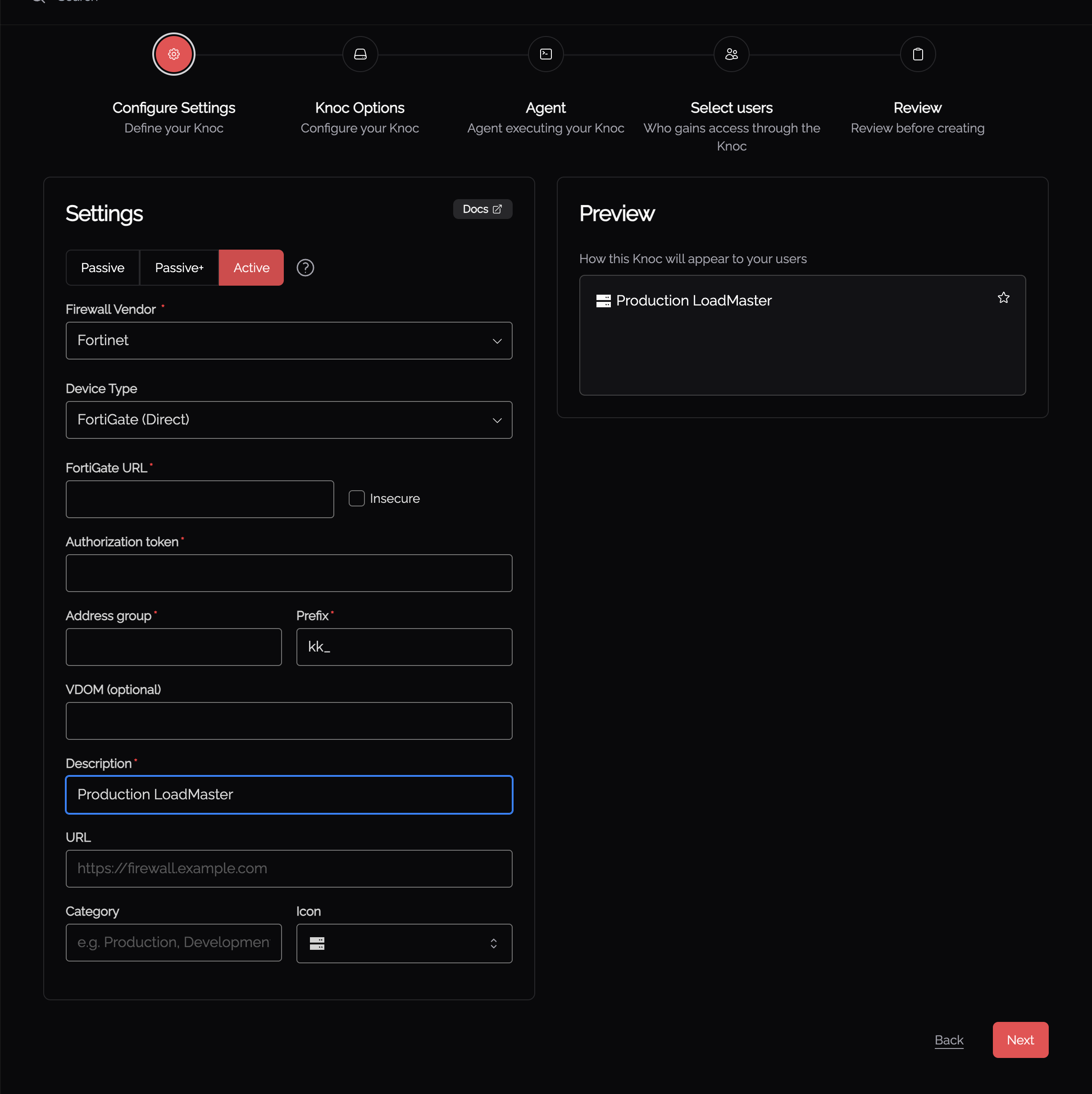
Configure Settings - enter the Kemp LoadMaster details. Select the Kemp LoadMaster vendor and fill in the URL, username and password. Tick Insecure only for a self-signed certificate.
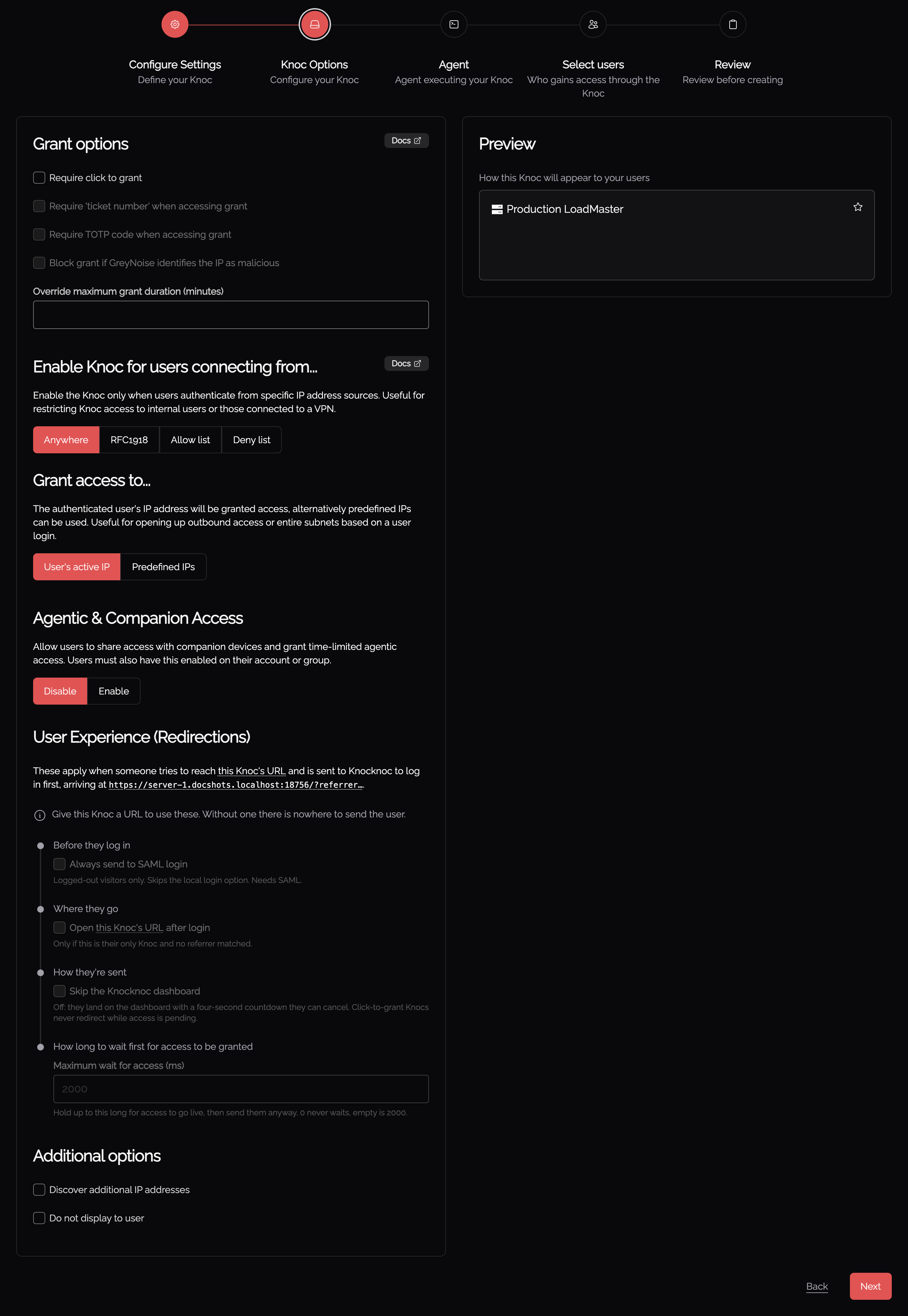
Knoc Options - set the grant behaviour.
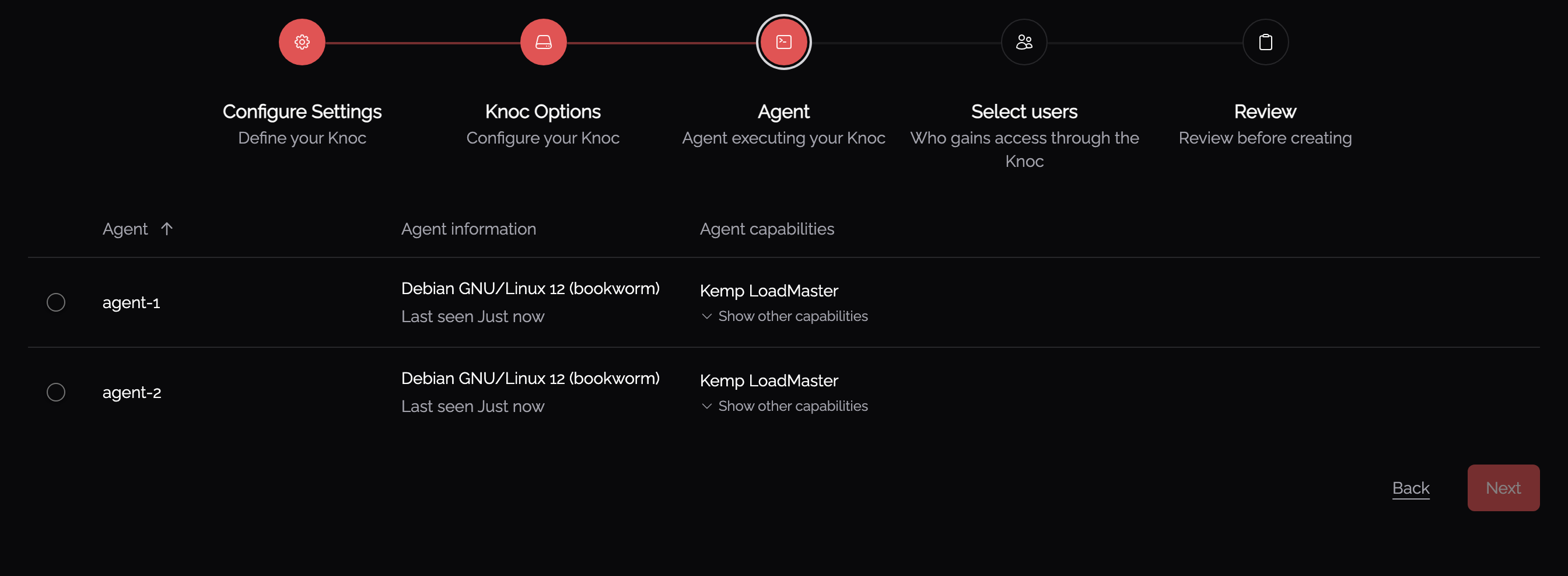
Agent - choose the agent that reaches the LoadMaster. Only agents that support the Kemp LoadMaster backend can be selected.
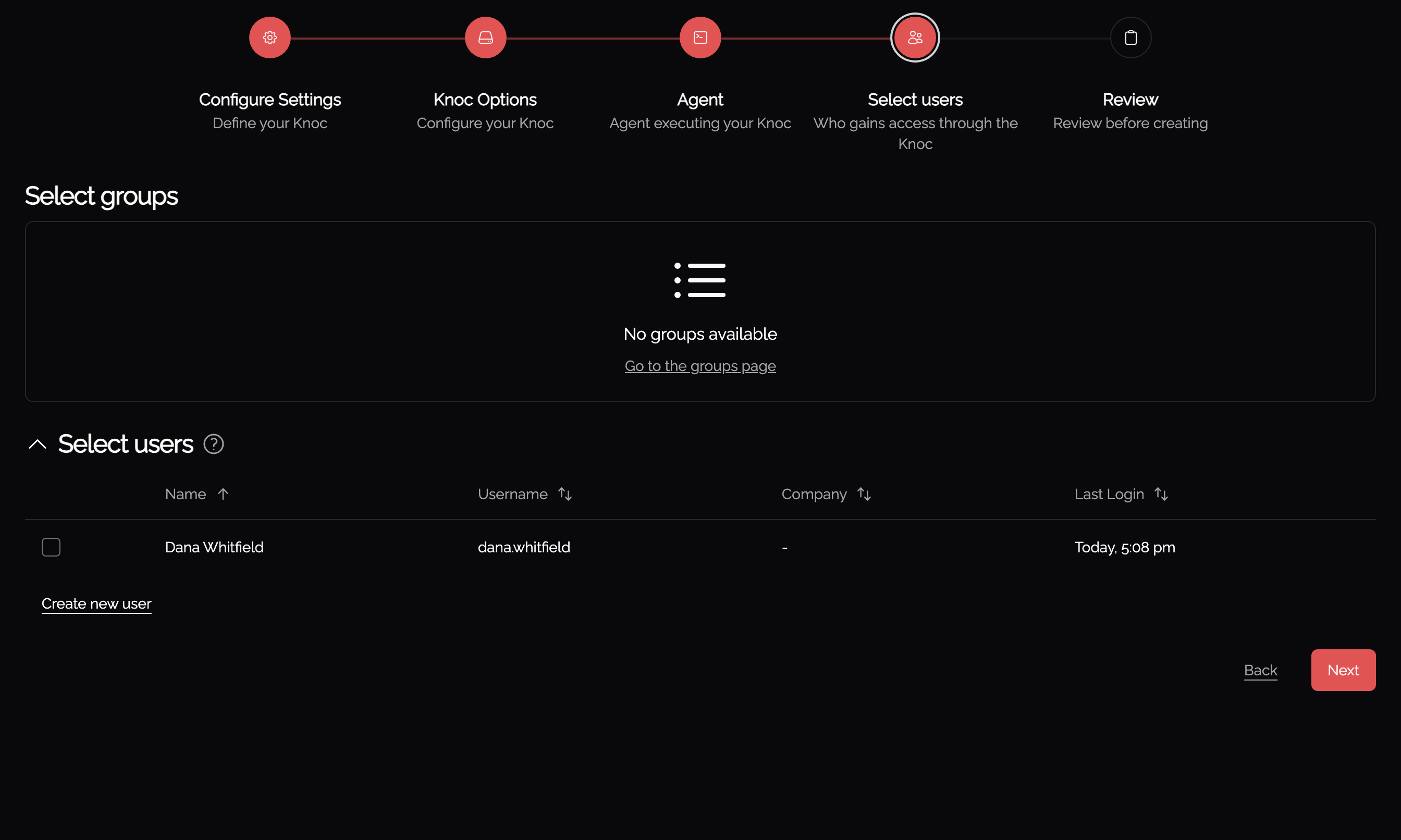
Select users - grant access to users or groups.
Review - run the connection check and create the Knoc. The read-only connection check confirms the LoadMaster is reachable and the allowlist is readable before you save.
Error Codes
When a Kemp LoadMaster operation fails, Knocknoc shows the relevant error code in the wizard. Use the tables below to find the cause and fix.
Connection and Authentication (KEMP000-KEMP049)
| Code | Description | Common Causes |
|---|---|---|
| KEMP000 | Failed to connect to the LoadMaster | Hostname unreachable, DNS failure, or connection refused. Check the LoadMaster is online and the Kemp LoadMaster URL is correct. |
| KEMP001 | LoadMaster authentication failed | HTTP 401. Verify the Username and Password are correct and the user has All Permissions. |
| KEMP002 | LoadMaster authorization failed | The user account lacks the permissions to manage the global ACL (HTTP 403). Grant the user All Permissions. |
| KEMP003 | LoadMaster TLS/SSL certificate error | Self-signed or untrusted certificate. Install a trusted certificate or tick Insecure in the backend configuration. |
| KEMP004 | LoadMaster connection timed out | Network timeout. Check connectivity between Knocknoc and the LoadMaster. |
| KEMP005 | API Interface not enabled | The API endpoint was not found (HTTP 404). Enable the API Interface under Certificates & Security > Remote Access. |
Allowlist Operations (KEMP100-KEMP149)
| Code | Description | Common Causes |
|---|---|---|
| KEMP100 | Failed to list the allowlist | Permission gap (see KEMP002) or the API Interface is disabled (see KEMP005). |
| KEMP101 | Failed to add an allowlist entry | The user can read but not modify the global ACL, or the address was rejected by the LoadMaster. |
| KEMP102 | Failed to remove an allowlist entry | The user can read but not modify the global ACL, or a transient LoadMaster error. |
Response Parsing (KEMP400-KEMP449)
| Code | Description | Common Causes |
|---|---|---|
| KEMP400 | Invalid or unexpected response | Transient LoadMaster-side error, or a proxy between Knocknoc and the LoadMaster rewriting the response body. |